By Paul Newcomb
For several years now, the English Readers editorial at Ernst Klett Sprachen has been looking for “state-of-the-nation” novels – the nation in question being the UK – suitable for reading in the upper levels of German-speaking schools. Many hours were spent reading titles that turned out to be either too obscure, too superficial, too… something. And then, like those elusive London buses, long awaited in vain, suddenly two came along at once…
How to Stop Time (2017) and Bournville (2022), now both published – in English and unabridged – as annotated school editions by Ernst Klett Sprachen, are two very different books, but they do have two things in common. Firstly, they both present a selective history of the UK, and secondly they are both written by top British authors.
Matt Haig’s fantasy angle in How to Stop Time: his protagonist, Tom Hazard, has a rare medical condition which radically slows down the aging process, and those afflicted, or possibly “blessed”, live for many hundreds of years. Thus, first of all we meet Tom as a young man in Shakespeare’s time, where he plays the lute in the Bard’s “band” at London’s famous Globe Theatre. Then we follow his seaboard adventures in the colonializing “Age of Exploration” of the late 18th Century, a very important – and controversial – era of British history, as it sets the tone for the British Empire, enabling it to peak in the Victorian Age. Later again, we see how music always plays a role in Tom’s seemingly endless life, as he becomes a bar pianist during F. Scott Fitzgerald’s “Jazz Age” in 1920s Paris.
All this is told from a flashback perspective from Tom’s life as a secondary school history teacher in today’s London. Thus, as well as being a tour through the ages, the book touches on many issues of modern life: some of Tom’s pupils are beset by mental health issues in a teeming, vibrant London that can leave kids behind – or even lead them astray.
Other topics covered in this wide-ranging book include: firstly, medieval witch hunts, which are thematically linked to the intolerance of “the other”, i.e. the ill-treatment of minorities. Secondly is the modern issue of technology vs. privacy. Tom’s identity is revealed against his will by the technology of the day, when his photo is published in the 1920s, then seen and recognized a hundred years later by his teaching colleague, Camille. In the accompanying Teacher’s Guide, this event is linked to today’s use, or misuse, of social media. To explain: Tom and his fellow sufferers are forced to hide their condition by an autocratic “organization”, run by a shady guy called Hendrich, and Tom’s inner struggle and depression are rooted in his having to choose between oppressive obedience to the organization on the one hand, and living an authentic and open life on the other. Being true to oneself is an important theme in the book, and is explored in the Teacher’s Guide under the headline of “Impostors”. It is also linked to LGBTQ issues, which are examined in one of the two accompanying Klausuren.
The book is suitable for 12th Grade students working on the topics of the UK and growing up / mental health.
*
Jonathan Coe is widely admired as one of Britain’s foremost politicized novelists – but his plots, for example in the very successful Middle England, often have a personal, almost soap opera feel. He achieves this mix by weaving his characters and their families’ lives closely into the political context of the day.
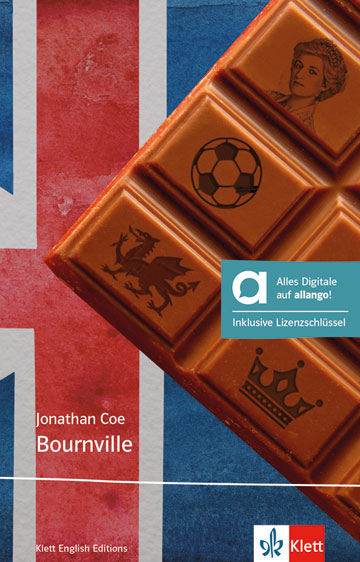
An example of this is in our second novel, Bournville, when a character, Peter, finally comes out as gay, and this tough honesty and facing up to his true self is juxtaposed by the Prime Minister, Tony Blair, reading in church from the Bible about the nature of love, to a global audience during the funeral of Princess Diana in 1997. As this is being broadcast on TV, we read about Peter, who, in a scene with explicit content, is at home enjoying his first gay sex adventure. Or when another character, in 1992, is involved in trade negotiations between Britain and the EU in Brussels. We read and we laugh at this description of the “chocolate war”: it is a superbly satirical sequence in the book. But, and this is the nature of good satire, of course, we know too that there is a strong element of truth in nationally elected politicians in Brussels arguing with each other about the intrinsic virtues and true and nature of… their national chocolate. To explain: Bournville is the traditional production centre of British chocolate – those of you with a sweet tooth: read the book to find out more; plot spoiler: Milka is also mentioned in the context of the World Cup Final in 1966!
In Bournville, Coe stays true to this unique mix of everyday family sagas and the larger political picture, but this time the story is in seven distinct eras and generations. Starting in 1945, against a background of the celebrations on “VE Day”, Victory in Europe, at the end of WW2, and ending with the 75th anniversary of that event, which was widely celebrated in Britain in 2020. Other public events in the book include: the coronation of Queen Elizabeth II in 1953, the Investiture of Charles as the “Prince of Wales” (nobody asked the Welsh about this!) in 1969, the wedding of Charles and Diana in 1981, and Diana’s funeral in 1997. It is important that Coe himself stresses that this novel is not a history of the monarchy, but of an ordinary family. The monarchs are there, and again and again in the book they represent a Britain divided by social class, but they – or rather, the celebrations surrounding them – do bring people together, too.
Bournville, which is a real place, near Birmingham, and near where Coe himself grew up, shows us a Britain that, although often deeply racist, is also capable of multiculturalist tolerance; that, although obsessed with tradition, is also able to embrace modern industry; and although deeply connected with an out-of-date, distant monarchy, also fosters refreshing political and social change.
The book can be read by 12th Grade students specializing in the UK and integration issues in general.
*
Both Bournville and How to Stop Time are long, challenging reads, and with that in mind, both Guides offer approaches which enable a “Part-by-Part” reading process, whilst still covering the topics mentioned above.
Annotated versions of both novels (complete with digital vocabulary-learning aids) are available now, as is the Teacher’s Guide to How to Stop Time. The Guide to Bournville will be published in 2026.